How to read Vietnamese Dong and avoid confusion first time
How to read Vietnamese dong: VND has many zeros so first-time travelers may be confused. For example, 50,000 & 500,000 VND look similar, so always double-check.
When you first come to Vietnam, you will find that VND money is easy to confuse because it has too many zeros and similar colors. The trick is to cover the last three zeros and focus on the first number to avoid giving the wrong money.
Learn basic knowledge about the Vietnamese Dong
When I first travel Vietnam, the first lesson I had to learn to confidently shop was to learn the basic knowledge about the currency here. I realized that Vietnamese money has an international code of VND, but on signs or menus, people often abbreviate it with the letter “d” after the number.
Understanding the basics of Vietnamese Dong
For foreign visitors, how to read Vietnamese dong is quite easy to remember: 100,000 VND is “one hundred thousand”, and 1,000,000 VND is “one million”. I also like the fact that Vietnam doesn’t use coins, making travel wallets much lighter.
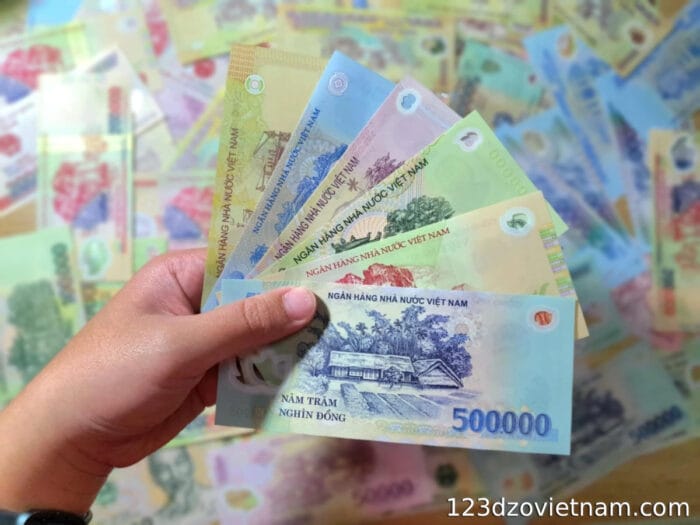
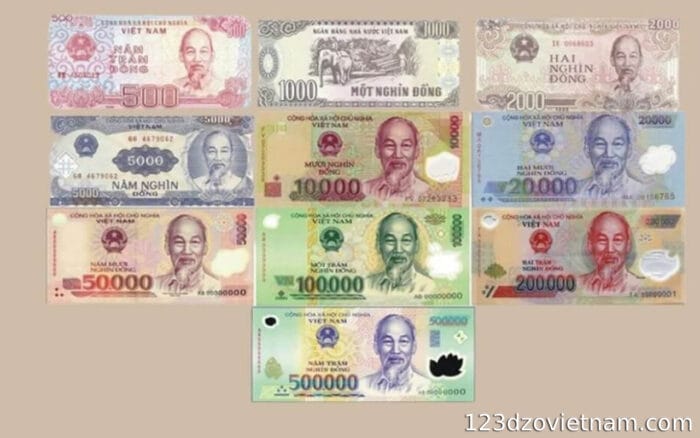
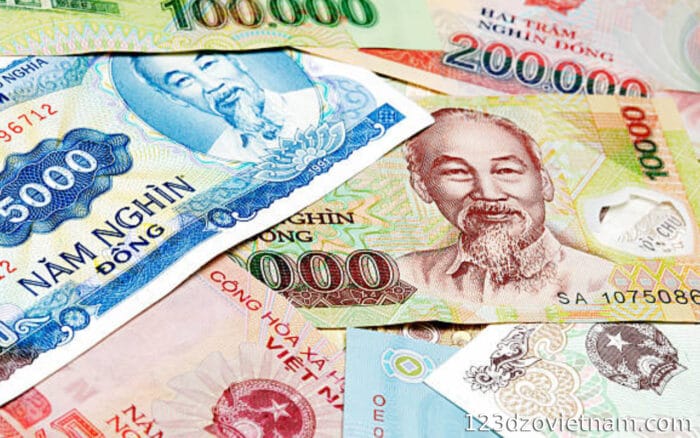
The currency system here is divided into two types of materials, small denominations from 5,000 VND or less are made of cotton paper, while large denominations from 10,000 VND to 500,000 VND are made of high-quality polymer material, waterproof, and have a unique transparent box.
The design of these polymer bills is very beautiful, with a portrait of President Ho Chi Minh printed on the front and famous landscapes on the back, such as the Temple of Literature (green 100,000 VND bill) or Ha Long Bay (orange-brown 200,000 VND bill).
Polymer bills with portrait of President Ho Chi Minh in most.
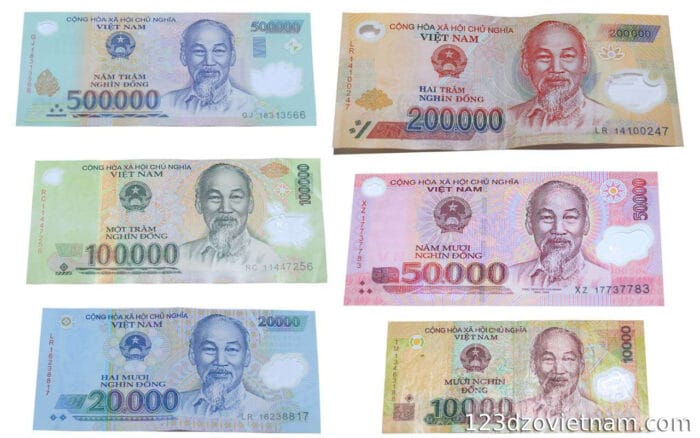
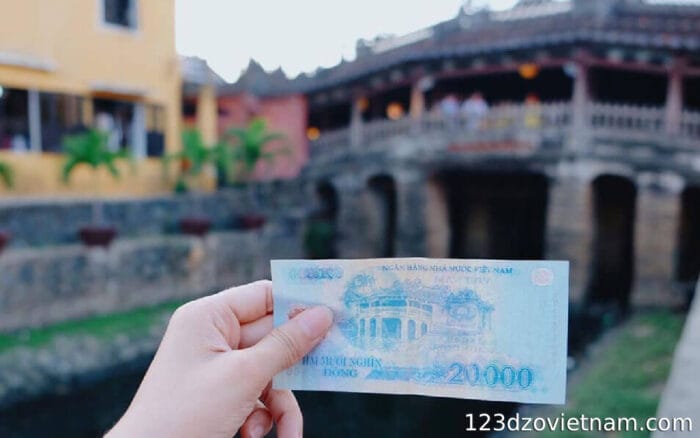
Each denomination has a distinct main color, although sometimes I still have to look carefully to avoid mistakenly giving the 20,000 VND bill and the 500,000 VND bill because their blue tones look quite similar at first glance.
How to read Vietnamese Dong and popular denominations
When starting to explore Vietnam, getting used to the numbers tens and hundreds of thousands can be quite overwhelming, but just understanding how to read Vietnamese dong will make shopping and payment a lot easier.
#1. How to read Vietnamese dong
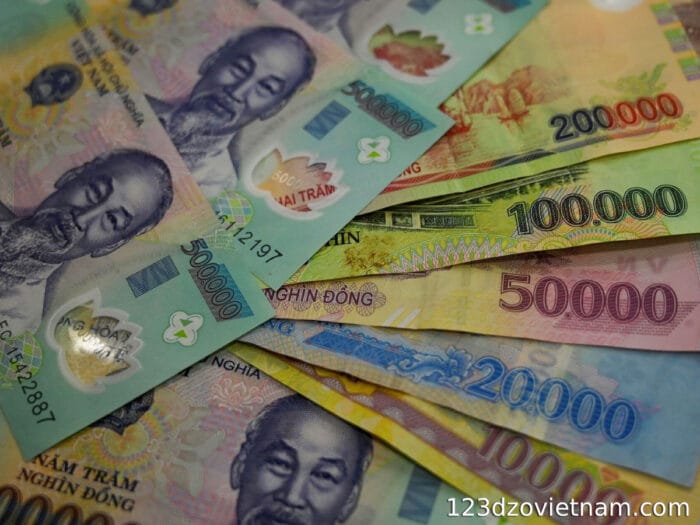
To avoid getting confused by too many zeros, I learned an extremely useful trick to apply the “remove three zeros at the end” rule. Local people or restaurant menus often shorten the thousands unit to the letter “k” (for example, 20,000 VND will be written or spoken as 20k).
How to read Vietnamese dong – Remove 3 zeroes at the ends and insert ‘k’ in place instead.
When communicating in English, instead of reading the full “twenty thousand”, they simply say “twenty” and automatically understand it as thousands. Thinking in terms of numbers ahead helps me calculate quickly and never get confused when paying.
#2. The most common denomination of VND
During the trip, a common question mark was that my wallet mainly revolved around popular polymer denominations from 10,000 VND to 500,000 VND. I usually divide them into color groups such as 10,000 VND (yellow-brown), 50,000 VND (dark pink), 100,000 VND (green), and 200,000 VND (brown orange).
Common denominations of Vietnamese dong – understand the colours!
However, the biggest challenge is the pair of 20,000 VND bills (blue) and 500,000 VND bills (blue). I still vividly remember the first day I took a taxi. Because I couldn’t distinguish colors under the dim light at night, I carelessly withdrew a 500,000 VND bill and gave it to the driver to pay for the ride, which was only 20,000 VND.
Luckily, the very kind driver laughed loudly and showed me the difference between the two bills, otherwise, I would have unfairly lost a lot of money just because of my negligence. After that time, I always had to look carefully at the preceding numbers instead of just glancing at the color when withdrawing money from my wallet.
05 common mistakes when reading VND money
Even with a few basic tips, the journey of using VND money for foreign tourists in the early days still cannot avoid confusion. Below are the 5 most common mistakes that most tourists easily make when first exposed to how to read Vietnamese dong
Common mistakes when reading Vietnamese Dong
Harmful confusion between 20,000 VND and 500,000 VND bills: both denominations have a blue tone, making it easy for tourists to mistakenly give the largest bill for an item of small value when it’s dark or in a hurry.
Dizzy because of incorrectly counting the number of zeros: facing a long string of zeros on a bill is really a brain-balancing problem. Just looking at one missing or extra zero will mean the value of the item has been miscalculated tenfold.
Confused by the “k” symbol on the menu: when entering a restaurant or coffee shop, many tourists often freeze for a few seconds when they see the price written like “35k” or “50k”. At this time, many people will quickly look up 1 Vietnamese dong to AUD to easily visualize the price.
Confusion between old and new bills: the new polymer 10,000 VND bill and the old cotton paper 1,000 VND bill have quite similar yellow-brown tones, easily causing foreigners to fumble and waste time distinguishing when standing at the counter to pay.
Not yet adapted to not having coins at all: because they are used to using coins in their home country, many tourists feel very strange when receiving change in the form of tiny paper bills, or sometimes with a few sweets instead of a few hundred coins.
05 Tips to help avoid confusion when using Vietnamese dong
To avoid falling into bad situations or losing money unfairly, as I did in the early days, besides researching how to transfer money to Vietnam, equipping yourself with a few pocket rules is extremely necessary. Here’s a tip to help you avoid confusion:
Tips to help avoid confusion when using Vietnamese Dong
Arrange money in ascending order: I always arrange the bills in my wallet from small to large and keep the 500,000 VND bill separate in the deepest compartment to avoid withdrawing by mistake when in a hurry.
Memorize images of landscapes: instead of counting the number 0, I remember the color and back of the money, like whenever I see a picture of Ha Long Bay, an orange-brown bill, I immediately know it’s 200,000 VND.
Apply the rule of covering three zeros: every time I look at an invoice, I automatically cover up the last three zeros to mentally convert to the unit “k” quickly.
Check the money in a well-lit place: with the blue pair of 20,000 VND and 500,000 VND, I always turn on the phone light to carefully check the number if I have to pay at night.
Always prepare small denominations: I always keep change of 10,000 VND and 20,000 VND in my outer pocket so I can easily pay for drinks or motorbike taxis without having to pull out a large wad of money to count.
Conclusion
Although the first few days may make you a bit dizzy, getting used to how to read Vietnamese dong is actually a very interesting experience and not difficult at all if you master the basic rules above. Hopefully, these pocket tips will help you spend with complete confidence and enjoy a complete trip to Vietnam.