Hanoi to Hai Phong train | Full schedule and service review
Hanoi to Hai Phong train runs from around 6:00 AM, travel time 2.5-3 hours, fares range 70,000 – 150,000 VND ( about 4 – 9 AUD) depending on seat class type.
Experiencing Vietnam’s railway system for the first time on the Hanoi–Hai Phong route, I was truly impressed by the sense of relaxation as I gazed out the window at the suburban scenery on the classic train. The journey was quite smooth and swift, a wonderful way to kick off my exploration of the port city.
Overview of the Hanoi – Hai Phong train route
Taking Hanoi to Hai Phong train is my top choice whenever I want to experience travel Vietnam. Covering a distance of approximately 102 km, the journey takes just 2.5 to 3 hours—making it an ideal option for day trips or short business travel.
#1. The latest Hanoi – Hai Phong train schedule
After conducting some research, I found that trains running in both directions have frequent schedules, offering a wide range of departure times spread throughout the day. This makes it easy for passengers to select a trip that perfectly suits their travel needs:
The latest Hanoi – Hai Phong train schedule
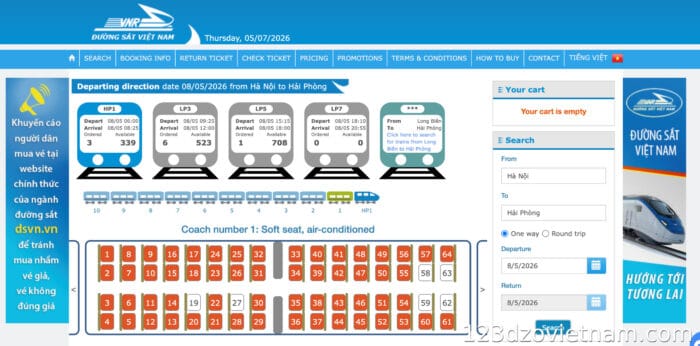
For the Hanoi-to-Hai Phong route, the main train services, departing from either Hanoi Station or Long Bien Station, include HP1 (6:00), LP3 (9:20), LP5 (15:15), and LP7 (18:15).
For the Hai Phong-to-Hanoi return route, trains run frequently throughout the day, designated as LP2 (6:10), LP6 (9:05), LP8 (15:00), and HP2 (18:40).
For this particular trip, I opted for the LP3 service, departing at 9:20 AM. I found this schedule to be incredibly convenient for tourists, as it eliminates the need to wake up at the crack of dawn; arriving at 12:00 PM is the perfect time to grab lunch and check in to your hotel immediately.
#2. Train ticket prices and seating class experiences
In terms of cost, this route is considered one of the most affordable options available. Its stable pricing makes it suitable for a wide range of passengers, particularly frequent travelers or those looking to keep their travel expenses to a minimum. The current specific fare rates are as follows:
Train ticket prices and seating class experiences
Hard Seat: Approximately 70,000 – 100,000 VND (equivalent to 4.5 – 6.5 AUD). This is the most budget-friendly option, though it can become quite tiring on long journeys.
Soft Seat (Air-conditioned): Approximately 100,000 – 150,000 VND (equivalent to 6.5 – 9.5 AUD).
High-Quality Cabin: Approximately 160,000 – 200,000 VND (equivalent to 10.5 – 13 AUD).
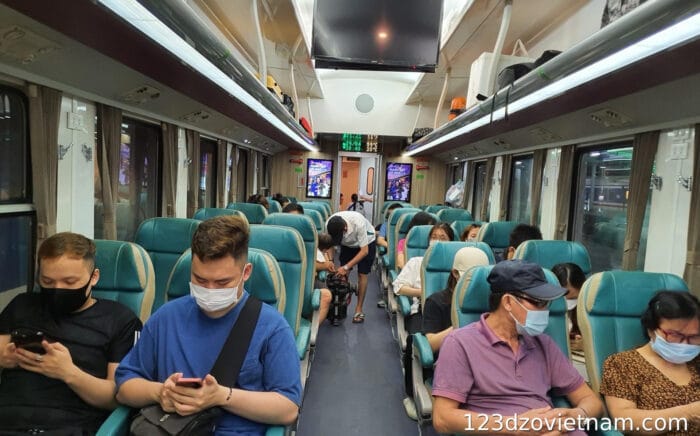
I decided to opt for the air-conditioned soft seat for my Hanoi to Hai Phong train journey. Compared to the hard seat, the soft seat offers a distinct improvement in comfort—featuring cushioned seating and a cool, air-conditioned environment—making it well worth the small additional cost.
When compared to the high-quality cabin, although the soft seat lacks the same level of luxurious amenities and services, I found it to be the most balanced choice between cost and comfort, especially given that the travel time is only about three hours.
Review of the Hanoi – Hai Phong train service
Continuing my journey, I would like to share a more in-depth review of the public transportation I experienced on this railway route, specifically highlighting the differences between the traditional trains and the newer tourist trains.
#1. The Standard Hanoi – Hai Phong train experience
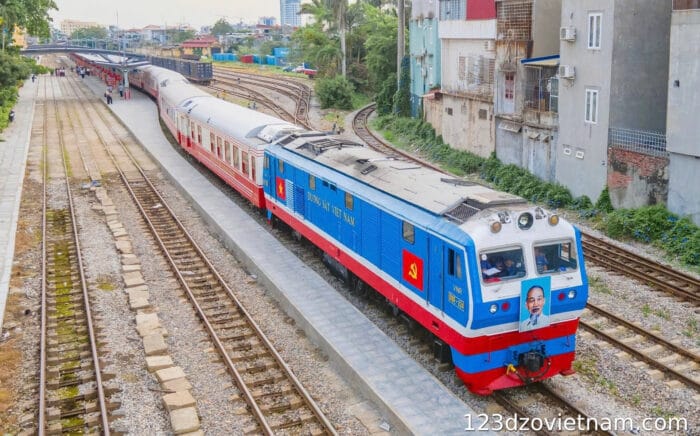
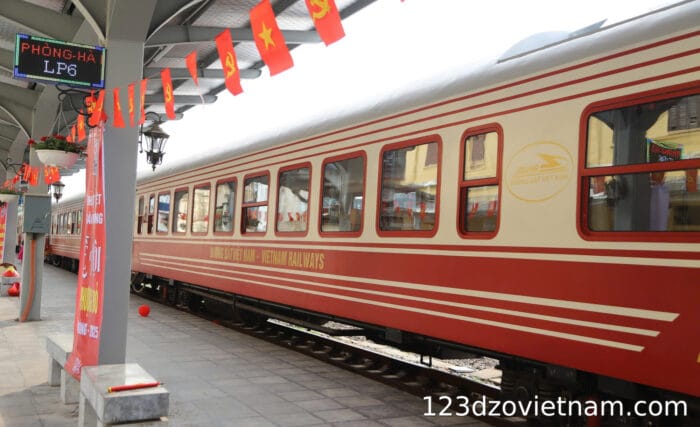
For this initial trip, I chose to ride the standard trains (designated by the code LP). What impressed me most, and indeed, the very reason I love traveling by train, was the ever-changing scenery unfolding outside the window.
The Standard Hanoi – Hai Phong train experience
In particular, the sensation of the train gliding slowly across antique iron bridges—or along stretches of track running right alongside residential homes—offers a truly unique perspective on daily life in Vietnam.
Traveling by train not only allowed me to completely avoid the traffic congestion typically associated with driving, but also provided a quiet respite to truly rest my limbs and savor a slower pace of life. The air-conditioned soft-seat carriage I occupied featured an interior that, while basic, was clean; the air conditioning functioned reliably, and the onboard restroom facilities were consistently well-maintained and ready for use.
#2. The Hoa Phuong Do train experience (upgraded service)
Through conversations with fellow passengers and information gathered at the station, I learned more about the Hoa Phuong Do train (designated as HP1 and HP2). This is a high-quality tourist train featuring a modern design and offering a level of service that is significantly superior.
The Hoa Phuong Do train experience (upgraded service)
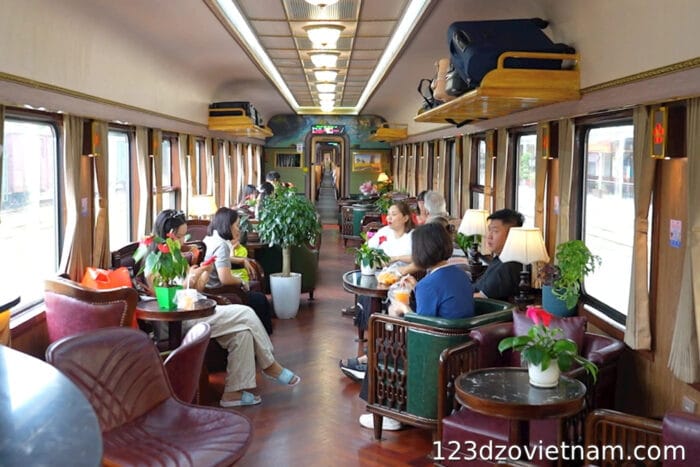
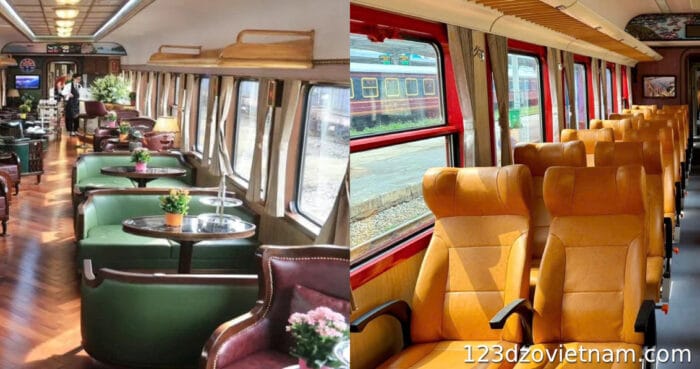
The train is fully air-conditioned, offers complimentary drinking water, and features an interior design modeled after a “luxury train” aesthetic, exuding elegance and sophistication. The seating options on this train are also quite diverse:
VIP Carriage (34 seats): Features premium leather upholstery and includes complimentary beverages and pastries. Ticket prices range from approximately 300,000 to 350,000 VND (approx. 19.5 – 23 AUD).
Swivel Seat Carriage (56 seats): A unique feature of this section is the seats’ flexible swivel mechanism, which makes sightseeing much easier. Ticket prices range from approximately 150,000 to 180,000 VND (approx. 10 – 12 AUD).
Standard Soft Seat Carriage (64 seats): Offers an affordable option suitable for daily commuting needs, priced at approximately 120,000 to 150,000 VND (approx. 8 – 10 AUD).
#3. Comparing standard trains vs. the “Red Phoenix” (Hoa Phượng Đỏ) train
After personally experiencing the standard train from Hanoi to Hai Phong, and taking the time to observe and compare it against this high-quality train, I found the differences to be absolutely striking:
Comparing standard trains vs. the “Red Phoenix” (Hoa Phượng Đỏ) train
Criteria
Standard Train
Red Phoenix Ship
Space & Interior
It features a traditional, somewhat dated style, with train cars that have been in service for many years. The interior is simple, leaning towards a basic aesthetic.
The Hoa Phuong Do train features a modern, renovated interior, complete with new flooring, matching curtains, and cozy, warm-yellow lighting, creating a professional ambiance reminiscent of an aircraft cabin or a luxury limousine.
Smoothness and Quietness
The rhythmic clatter of the tracks and the noise from adjacent carriages remain clearly audible, particularly when the train is traveling at high speeds.
With significantly improved soundproofing, the train operates smoothly and quietly, making it ideal for resting or working on a laptop throughout the journey.
Included Amenities
Only basic amenities are available to meet standard travel needs.
It is equipped with power outlets at every seat, complimentary drinking water, and upgraded restrooms that are clean, modern, and meet higher standards.
Sightseeing Experience
The windows are fixed glass panes; in some carriages, the glass appears slightly clouded due to years of use.
The glass windows are wider and more transparent, while swivel seats with adjustable orientation allow passengers to enjoy a more panoramic view of the Northern Delta.
Price
Approximately 6.5-9.5 AUD (100,000-150,000 VND), suitable for those who prioritize cost savings.
Hanoi Hai Phong Luxury train fares are approximately 2–4 AUD higher; however, in return, travelers enjoy a more comfortable, modern, and value-for-money experience.
Overall Experience
Suitable for those who enjoy a nostalgic, simple, and budget-friendly experience.
Much like the Heritage train Hue Da Nang, it offers the sensation of a genuine travel experience, but within a modern, comfortable, and far more pleasant setting.
How to book train tickets from Hanoi to Hai Phong
To begin my journey, I have two main options: booking a train from Hanoi to Hai Phong online, or purchasing one directly at the station. Given the advancements in technology, I prefer booking online, either through the official Vietnam Railways website or via e-wallet applications.
How to book train tickets from Hanoi to Hai Phong
The booking interface is quite intuitive, allowing me to actively consult the train car layout to pinpoint exactly which seats are still available. Upon accessing the site, I proceeded through the following steps:
Select train code and seat class: As previously mentioned, I chose train LP3 and the air-conditioned soft seat class. The system clearly displayed the fare for this selection: approximately 125,000 VND (equivalent to 8.2 AUD).
Payment and e-ticket receipt: Once payment was complete, I received my e-ticket—complete with a QR code—via both email and SMS. This was incredibly convenient, as I didn’t need to print a paper ticket; I simply saved an image of the QR code on my phone for staff to scan at the station’s ticket gate.
If you prefer a more traditional approach, you can visit the ticket counters for the Hanoi to Hai Phong train route directly at either Hanoi Station or Long Bien Station. However, this method sometimes involves waiting in line and makes it more difficult to secure a specific, desirable seat location.
Overall, the booking process was highly professional and efficient. With just a few simple steps, I was all set to embark on my exploration of the beautiful port city at an extremely reasonable cost.
05 Tips for taking the train from Hanoi to Hai Phong
Thorough preparation will allow you to enjoy a relaxing journey rather than having to rush at the last minute. Here are the steps I took:
05 Tips for taking the train from Hanoi to Hai Phong
Arrive at the station 20–30 minutes early: I always make sure to arrive ahead of time so I can leisurely complete the ticket check-in process and snap some photos at the historic Hanoi Station without feeling rushed.
Choose your departure time wisely: I prefer the LP3 train (departing at 9:20 AM) so that I arrive just in time for lunch, or the HP1 train (departing at 6:00 AM) if I want to make the absolute most of a full day of exploration.
Tips for securing a window seat: When booking tickets, I always prioritize a window seat facing the direction of travel; this allows me to fully enjoy the passing countryside scenery while avoiding motion sickness.
Have your documents ready and pack light: I keep my ID and ticket QR code easily accessible on my phone. It is best to pack your luggage compactly so it can be easily stowed on the overhead racks above your seat.
Bring a light jacket: The air conditioning in the soft-seat carriages runs quite cold, so bringing a light jacket helps ensure I stay comfortable throughout the three-hour journey.
Conclusion
The train journey from Hanoi to Hai Phong is an incredibly worthwhile experience at a very reasonable cost. With its safety, punctuality, and the picturesque countryside scenery passing by your window, I believe the Hanoi to Hai Phong train is the absolute best choice for you to begin your exploration of the port city in a relaxed and enjoyable manner.